

As one of the most prestigious stops on your Rome trip, the Galleria Borghese ranks at the top of every art lover’s itinerary thanks to its unparalleled Renaissance and Baroque collections. However, visiting this magnificent museum — also known in architectural literature as the Casino Nobile — doesn’t offer the flexible experience of buying a ticket at the door and getting lost inside for hours, as you can at other European museums.
Because the space was originally built through the vision of Cardinal Scipione Borghese rather than as a modern gallery, museum management enforces a strict rule to protect the historic building’s microclimate (especially the temperature and humidity balance) and the security of its priceless artworks. The time you can spend inside is limited to exactly two hours (120 minutes). Given the sheer volume of masterpieces, this rule creates panic for many visitors who don’t know what to prioritize and worry they won’t have enough time.
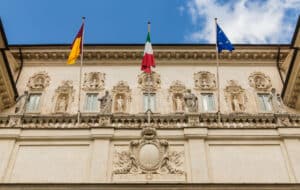
Galleria Borghese’s villa-like setting sets the tone for a masterpiece-packed, timed visit. Photographer: nikolpetr
So, with the clock ticking and the countdown already running, how will you manage this massive collection without panicking? We believe this is a truly important question. By skipping the standard route followed by the majority and building a rational 2-hour Borghese Gallery strategy, you can turn this time limit into a masterfully planned art feast instead of a race. Let’s break down the field tactics, crowd-dodging methods, ticket alternatives, and logistical strategies you need to use your time with maximum efficiency..
Don’t Let Time Anxiety Kill Your Artistic Enjoyment
It’s abundantly clear that constantly checking your watch while touring will kill the joy you get from the art. Instead of examining the flawless marble craftsmanship and the kinetic energy that brings Gian Lorenzo Bernini’s sculptures to life, tracking the minute hand on your watch could turn into one of the biggest disappointments of your Rome visit. Trying to calculate how much time to spend in each room creates mental fatigue, causing you to miss the historical details embedded in the artworks and the messages the artist intended to convey.
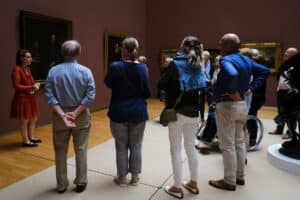
A specialist guide can turn the two-hour limit into a calm, perfectly prioritized route. Photographer: Alexandros Michailidis
At this point, there are various alternatives shaped by your budget and expectations to help optimize your time. If you want to hand the “What should I look at, and for how long?” decision entirely over to a professional, touring the Borghese Gallery with a specialized art history guide is a sensible investment. They’ll optimize the route for you and ensure you spend exactly the right amount of time in front of Bernini’s masterpieces. An expert guide knows the indoor flow by heart and directs you to the right halls when crowds are at their lightest. To completely focus on the artworks without feeling rushed and to flawlessly use those 120 minutes, look into third-party options like a Galleria Borghese Expert Guided Tour or Art History Tour. Besides eliminating the stress of finding tickets that sell out months in advance, these tours transform your two hours into a fluid, minute-by-minute planned art recital.
To be completely honest, though, these private tours are significantly more expensive than an official entry ticket (often reaching 3-4 times the base price). If you don’t want to stretch your budget, the official audio guide — which you can rent for a mere 5 Euros at the museum’s official ticket window — is a fantastic and economical alternative. Even though the audio guide leaves the crowd-dodging up to you, it’s a highly satisfying way to learn the technical and historical details behind the artworks at your own pace.

The audio guide is the best budget add-on for context–without sacrificing your pace. Photographer: BearFotos
The Mechanics Behind the Strict 120-Minute Rule
Why does the Galleria Borghese enforce such tight time limits? Originally built in the early 17th century as a private summer villa (Villa Borghese Pinciana) by Cardinal Scipione Borghese (nephew of Pope Paul V and one of the era’s greatest art patrons), this building has a rather compact structure compared to massive museum complexes. To prevent stampedes, ensure artwork security, and offer every visitor a quality viewing area to circle the sculptures, only 360 people are allowed inside during each two-hour session.
The actual scientific reason behind this rule is preservation. According to the restoration and conservation guidelines of the Italian Ministry of Culture’s Museums Portal, it’s mandatory to prevent the carbon dioxide increase and humidity fluctuations (microclimate) caused by 360 people breathing simultaneously from damaging the centuries-old paintings, wooden panels, and ceiling frescoes. When your chosen time slot is up, security guards systematically and uncompromisingly empty the halls. You aren’t allowed to stay inside for even one extra minute. This catches uninformed tourists off guard, causing them to rush frantically from one hall to another. Most visitors assume they have to walk briskly through all the rooms when they hear about the two-hour limit. However, with the right spatial planning, 120 minutes is more than enough time to fully digest this extraordinary collection.
Reverse Route Strategy from Field Experts
What happens when the museum doors open and 360 people step inside? Nearly ninety percent of visitors instinctively charge toward the massive marble sculptures on the ground floor (the Museo section). Since the museum’s most iconic pieces live on this floor, everyone rushes straight for the Bernini sculptures the moment the doors open, instantly forming a massive human bottleneck in the building’s narrow corridors.
Our field experience and flow analysis have taught us this: As soon as you enter,bypass the crowd and take the spiral stairs straight to the upper floor, known as the Pinacoteca (Picture Gallery).You’ll get to examine paintings by High Renaissance master Raphael andd Venetian school pioneer Titian almost entirely alone. When you head downstairs 45 minutes later, that initial massive crowd will have already moved upstairs, leaving the Caravaggio works and the Apollo and Daphne sculpture entirely to you. This practical tactic is your main key to touring the museum without feeling suffocated by the crowds.
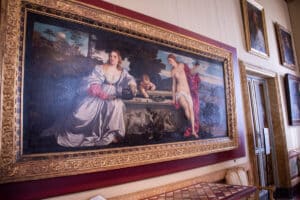
Photographer: lucarista
For full transparency, this **reverse route** tactic does have a minor downside: You’ll experience the chronological and thematic story carefully crafted by the curators and Cardinal Borghese in reverse. However, rather than trying to view the fine details of Baroque art over the shoulders of fifty-person tourist groups, making this small concession to absorb the art in a spacious environment is absolutely a rational and rewarding trade-off.
The First 45 Minutes: Upper Floor Dynamics
When you head straight to the upper floor (Pinacoteca), there are clear targets you need to focus on. Take a close look at The Deposition (Pala Baglioni) by Raffaello Sanzio (Raphael) and Sacred and Profane Love (Amor Sacro e Amor Profano) by Tiziano Vecellio (aka Titian) in this spacious setting. Finding a spot to stand in front of these massive paintings in a crowded room is usually quite difficult. But with the reverse route strategy, you can observe the philosophical symbolism, color transitions, and brushstrokes of the works down to the finest detail.
You can also make time for rare works by masters like Correggio and Domenichino. Don’t forget to notice the architectural depth added by the ceiling frescoes connecting the rooms, along with the three-dimensional illusions created by the trompe-l’œil technique. The silence of the upper floor offers the serene atmosphere you need to truly grasp these peak moments in painting.
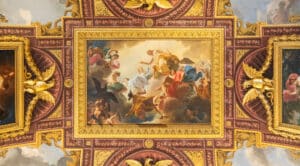
Look up! Borghese’s ceilings are part of the collection’s quiet “wow” moments.Photographer: Paolo Gallo
The Last 75 Minutes: The Ground Floor and Where Marble Comes to Life
Once you finish upstairs and head down to the ground floor, you’ll notice how much the crowd has thinned out. Under a time constraint, your approach to these sculptures must be highly practical. Bernini’s Baroque masterpieces aren’t designed to be pushed against a wall and viewed from a single angle; they’re meant to be examined by circling them 360 degrees, much like a theatrical stage.
As you approach The Rape of Proserpina (Pluto and Proserpina), notice how the marble stretches and looks as soft as real human skin right where the underworld god Pluto’s hands press into Proserpina’s thigh. In the Apollo and Daphne sculpture, inspired by Ovid’s epic Metamorphoses, focus directly on the rear diagonal of the piece to see the dramatic moment of metamorphosis as Daphne’s fingers transform into tree branches and roots. Another masterpiece that will grab your attention on the ground floor (in Sala Paolina / Room 1) is the Paolina Borghese (Venus Victrix) carved by Antonio Canova, the pioner of the Neoclassical movement. In this piece depicting Napoleon’s sister as Venus, closely examine the realistic indentations and fabric folds on the marble cushions.
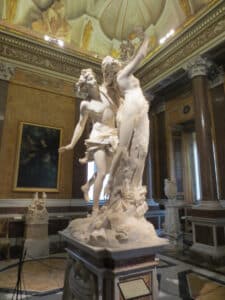
Circling the sculpture reveals the metamorphosis–Bernini’s marble changes with every angle. Photographer: FMilano_Photography
When you enter Room 8 (Sala del Sileno),where Michelangelo Merisi da Caravaggio’s works are displayed,stand in the center of the room to fully experience the famous chiaroscuro (contrast of light and dark / Tenebrism) technique featured in his paintings David with the Head of Goliath and Young Sick Bacchus (Bacchino Malato).Because the crowd has scattered to the upper floor, these paintings — which also hold the artist’s own psychological reflections — will be much easier to read..
Common Mistakes That Steal Your Time and Practical Solutions
It’s not just your indoor route, but also your logistical planning before entering the museum that directly impacts your two-hour window. To maximize this time and prevent any frustrating hiccups, you absolutely must avoid the following common mistakes.
- Falling for the Punctuality Trap and Late Penalties: If your entry time is 11:00 AM, arriving at the door at exactly 11:00 AM is the biggest mistake you can make. You need to get your tickets physically validated and leave your belongings in the cloakroom. Moreover, the museum’s policy is uncompromising: if you miss your time slot, your ticket is voided, and no refund is issued. We recommend being ready at the ticket office and cloakroom area on the lower level of the building (in the basement) 30 minutes before your scheduled time.
- The Cloakroom and Large Bag Rule: Galleria Borghese security rules are incredibly strict. All bags, backpacks, suitcases, and umbrellas larger than 21×15 centimeters must be left in the cloakroom. Waiting in long-lines to drop off and pick up your items eats up your pre-entry time. Bring a very small bag that only fits your cell phone, wallet, and passport. Consuming food and drinks inside, including water, is strictly prohibited.
- Accessibility and Wheelchairs (An Overlooked Detail): A critical point most travel guides skip is accessibility. Despite being a historical structure, the Galleria Borghese features a special entrance ramp and an elevator at the back of the building for visitors with limited mobility and wheelchair users. However, due to elevator capacity limits, large personal motorized wheelchairs might not be allowed; in this case, the museum management provides its own standard wheelchairs to visitors free of charge.
- The Wrong Shoe Choice and Tiring Floors: Standing non-stop on historical marble floors for two hours is physically exhausting because of the hard surface. Choose comfortable, practical walking shoes that fully support your feet.
- Wasting Too Much Time with a Camera and Prohibitions: Flash-free photography is allowed inside the museum, but tripods and selfie sticks are strictly forbidden. Spending your two hours constantly staring at a phone screen or trying to catch the perfect angle will cause you to miss the true three-dimensional forms of the artworks. Try to capture that unique transparency in the marble craftsmanship directly with your own bare eyes.
- Gift Shop Timing: If you’re planning to walk into the store and shop in the final five minutes of your visit, you’ll probably be directed outside without buying anything. The staff ushers everyone to the exit doors the moment time is up. Do your shopping before you start your tour, during the waiting period after your ticket validation.
Current Visit (2026) and Logistics Information
So, how much is the entrance fee, and how do you get tickets? The era of spontaneously buying tickets at the door is completely over. Due to limited quotas, tickets sell out weeks in advance. Your primary source for ticket purchases and current exhibitions should always be the Official Galleria Borghese Website.As of 2026, standard adult entry ticket prices vary between 13 and 16 Euros (**though prices can exceed this range during special temporary exhibitions). On top of this, there is a mandatory 2 Euro reservation fee for all ticket types. Even if you have a Roma Pass card, qualify for free entry by being under 18, or visit on the first Sunday of the month during the free entry (Domenica al Museo) promotion, you’re still required to reserve your time slot online and pay the mandatory reservation fee.
So where exactly is the museum? The facility is located at the eastern edge of the massive Villa Borghese park, which is protected within the boundaries of the UNESCO World Heritage Historic Centre of Rome. If you’re using public transit, after getting off at the Flaminio or Spagna subway stations, you’ll need to take about a 20-minute walk through the park (you can find route details on the Rome Tourism Board’s Villa Borghese Page). When planning your transit, you absolutely must factor in not just the subway ride, but also this walking distance along the park’s tree-lined paths. Otherwise, you risk being late for your reservation and voiding your ticket.
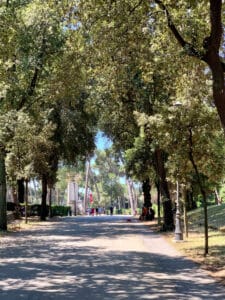
After the timed exit, Villa Borghese’s greenery is the perfect place to decompress and reflect. Photographer: Jan Hospodka
Turning the venues rules to your advantage, applying the reverse route tactic to dodge the crowds, and handing time management over to professional guides or the official audio guide will transform this unique Baroque collection into an art memory you’ll never forget. When you step outside the gallery’s heavy doors, you can joyfully digest the indoor details in the peaceful, green, and boundless atmosphere of the Villa Borghese gardens.
Thanks for reading!
Note: Featured Image by Yuri Turkov
Leave a Comment