
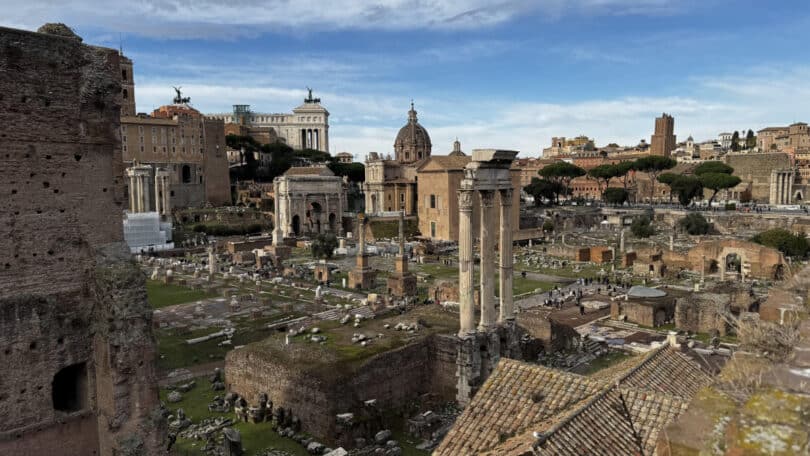
When you leave the imposing silhouette of the Colosseum (Amphitheatrum Flavium) behind and cross Via dei Fori Imperiali, you’ll encounter a vast valley spread between the Capitoline and Palatine hills. It’s filled with ruined columns, massive broken arches, and piles of stone that seem completely nameless at first glance. This is the Roman Forum (Forum Romanum)–the absolute heart of the ancient world and the center of administration, law, religion, and trade for the Roman Empire. Today, it’s recognized as one of the most valuable treasures on the UNESCO World Heritage Centre Historic Centre of Rome list.
Of course, you could just walk in and try to examine every single stone. But how do you map out an efficient route without getting lost in this massive open-air labyrinth–where directional signs are incredibly scarce and shaded areas are almost nonexistent–and without burning out under the Roman sun?
The main problem visitors face when exploring ancient ruins is “ruin fatigue”. This is a state of cognitive overload where the brain, exposed to too much visual stimulation, eventually starts blurring every historical detail together. If you don’t establish a solid field strategy and topographical plan, it’s inevitable that you’ll remember one of the world’s most important archaeological parks as nothing more than an exhausting, confusing, and sweltering walking trail. The real answer travelers are looking for when they search “how to navigate the Roman Forum and Palatine Hill” isn’t just map-reading skills. They need “insider” tactics based on actual field experience, detailing how and in what order to read the site. So, how can you conquer this historical chaos without getting tired or bored, unlocking the meaning behind every single stone?
Roman Forum Entry Strategy: Common Visitor Mistakes and Ideal Routes
The most common logistical mistake that drains your time and energy is falling for the “physical proximity” illusion and following the crowd out of herd psychology. The vast majority of visitors plunge straight into the chaos of the ancient city through the Largo della Salara Vecchia or the Arch of Titus (Arco di Tito) entrances right across from the Colosseum the second they finish their tour.
While this might look practical at first glance, it’s a physically punishing route. When you use these entrances, you’re forced into a grueling uphill trek straight into the sun along the historic Via Sacra (Sacred Way). Dropping you directly into the most crowded and chronologically confusing spot, this move is the number one trigger for ruin fatigue.
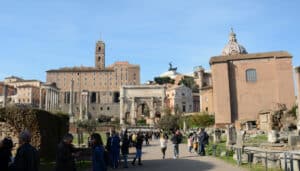
Visitors walking along the Via Sacra in the Roman Forum on a sunny day in Rome. Photographer: Fernando Uyaguari
The rational field strategy used by truly experienced travelers and Roman historians is completely different. Once you leave the Colosseum area, leave the massive crowds at the ticket booths behind, walk past the Arch of Constantine (Arco di Costantino), and head south down Via di San Gregorio for just four minutes. As you stroll along this peaceful, tree-lined street, you’ll spot the entrance to Palatine Hill (Mons Palatinus) on your right. We strongly advise starting your visit at this gate for a major strategic advantage. When you enter here, your entire route will be downhill from start to finish, letting gravity do the work. Plus, this entry point is a much more accessible and inclusive option for visitors using wheelchairs or strollers, offering easier access to the site’s elevator connections.
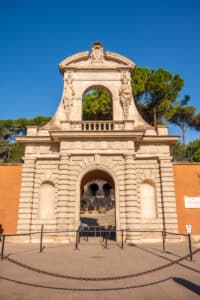
Starting at Palatine Hill gives you a calmer entry point–and an easier, mostly downhill route. Photographer: Jeff Whyte.
By using this gate, you kick off your tour on Palatine Hill–the exact place where Rome’s legendary founders, Romulus and Remus, began their story, and where post-Republic emperors like Augustus and Domitian built their colossal palaces (Domus Flavia and Domus Augustana). When you reach the terrace of the 16th-century Farnese Gardens (Orti Farnesiani) at the summit, the entire Roman Forum unfolds beneath your feet in a spectacular panorama. Once you’ve mentally mapped out the area’s general layout and physical bird’s-eye view, you can walk downhill, moving against the crowds, and easily reach the heart of the ancient city without breaking a sweat.
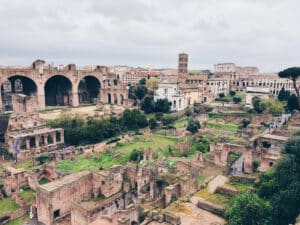
The smartest way to “read” the Forum is to map it from above before descending into the ruins. Photographer: Max Skorokhod
The Power of Storytelling and Free Alternatives
Making sense of this massive archaeological park on your own is way more exhausting than it sounds. Wandering through the Roman Forum with nothing but an open guidebook or a webpage is no different from trying to solve a giant puzzle with missing pieces under the scorching summer sun. No matter how much you read, it’s hard to instantly grasp whether that massive marble block on the ground was once a step to the Senate building, a ruined column of the Basilica Aemilia, or just an ordinary ancient market stall (Tabernae).
But when you explore the site with a true storyteller–a licensed, professional guide who knows the area inside out–those seemingly random, scattered stones will instantly transform in your mind into a magnificent, three-dimensional ancient city.
Your expert guide won’t just point at an empty space; they’ll bring to life the exact spot where Julius Caesar’s body was cremated, the triumphal processions of victorious generals down the Via Sacra, and the heated debates of senators at the Rostra podiums. In reality, you aren’t just buying a tour here; you’re buying a vision that lets you look at bare stone and see the original building and the atmosphere of the era. To avoid wasting hours in exhausting ticket lines and to turn the ruins into a real story in your mind, we highly recommend booking a Colosseum, Roman Forum, and Palatine Hill Priority Guided Tour. This step will ensure you channel your energy in the right direction.
However, to be completely honest and transparent, private guided tours can put a dent in your travel budget. If you want to plan your trip more economically, you can download the completely free Parco Colosseo mobile app provided by official authorities, or listen to free audio guide podcasts from travel experts like Rick Steves. While these digital alternatives don’t offer the interactive Q&A perks of a live guide, they’re fantastic options that let you explore at your own pace while protecting your budget.
Current Ticket Prices, Official Channels, and Strict Visiting Rules
The answers to “What is the Roman Forum, where is it, and how much is the entrance fee?” are quite straightforward. The Roman Forum and Palatine Hill make up the ancient administrative center located in the valley between the Colosseum and Piazza Venezia in downtown Rome, combined into a massive archaeological park under a single ticket umbrella.To perfect your planning, be sure to check the Official Tourism Site of the Municipality of Rome for temporary exhibitions and general itinerary announcements before your trip.
To avoid paying commission fees and to snag the most cost-effective option, your first stop should always be the Parco archeologico del Colosseo Official Website. As of 2026, the current standard ticket price on the official site is around 18 Euros (excluding the minor online booking fees added by the system). This standard ticket guarantees you a timed-entry reservation to the Colosseum and a one-time entry to the Roman Forum and Palatine Hill area that you can use within 24 hours.
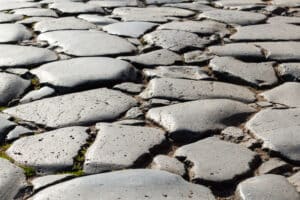
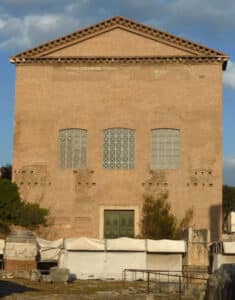
If your trip happens to fall on the first Sunday of the month, keep in mind that entry is completely free under the “Domenica al Museo” (Sunday at the Museum) initiative.However, the extreme crowds on these days will easily double your ruin fatigue. But if you can stretch your budget and time a bit further, we highly recommend grabbing the 24 Euro Full Experience ticket. These comprehensive tickets grant you access to enclosed spaces protected by special climate control systems, known as S.U.P.E.R. (Seven Unique Places to Experience in Rome). Boasting incredibly well-preserved frescoes, exclusive spots like the House of Livia, the House of Augustus, and the Church of Santa Maria Antiqua are fantastic hidden sanctuaries that most tourists don’t even know exist. The most critical rule to watch out for when buying your tickets is the “nominative ticket” (ID matching) requirement. Implemented to stop scalping and strictly enforced in 2026, this rule dictates that the names you enter during purchase must perfectly match the names on the official ID or passport you present at security. If you use a nickname or leave a name incomplete, site staff will absolutely deny you entry. Plus, the chances of finding physical tickets at the door are virtually zero; all reservations must be made online in advance. Since tickets on the official site can sell out weeks ahead due to limited capacity, we recommend securing your spots through authorized agents (please double-check their official status) selling Roman Forum and Palatine Hill Fast Track Tickets. Paying a small service fee to eliminate the risk of being left outside is a completely legitimate Plan B. Once you understand the topography of the ancient park, you need to maintain your physical stamina. Here are the essential rules you should follow to use your energy efficiently in this massive, millennia-old open-air museum: Refill for free at the Nasoni fountains–hydration is your best defense against ruin fatigue. Photographer: Uunal Beautiful underfoot, brutal on thin soles–proper walking shoes make or break your day. Photographer: Viacheslav Lopatin Instead of wasting your energy on every nameless column or minor detail, you can completely eliminate mental fatigue by building your route around these key historical highlights: A perfect “anchor monument” to understand how Rome’s political power once functioned. Photographer: MiEcBo Instead of wandering lost on unmarked paths and burning through your energy under the sun like an ordinary tourist, the experience of this ancient city changes completely when you enter through the right gate and focus on the real stories behind the stones using official sources. When you rely on strategic planning rather than surrendering to ruin fatigue, every step you take while feeling the spirit of the place (Genius Loci) transforms into an unforgettable discovery in one of the most fascinating locations in world history. Thanks for reading! Featured Image Credit: WichoPicsField Tips to Prevent Ruin Fatigue

Key Points Not to Miss When Planning Your Route
Leave a Comment