

85 Reviews
from €95.00 EUR
Duration: 3 Hours
Organized by: Ticketstation SRL
Trade the queue for time with masterpieces. With a reserved entry time and a licensed guide, you move smoothly from the hush of the Vatican Gardens to the headline galleries of the Vatican Museums and, finally,the Sistine Chapel—where Michelangelo’s vision unfurls overhead like a sky made of paint. Wondering how to fit so much into a single visit without feeling rushed? This itinerary is designed to do exactly that, balancing calm green spaces with curated highlights and clear, friendly guidance.
The Vatican Gardens: a quiet prologue behind the walls
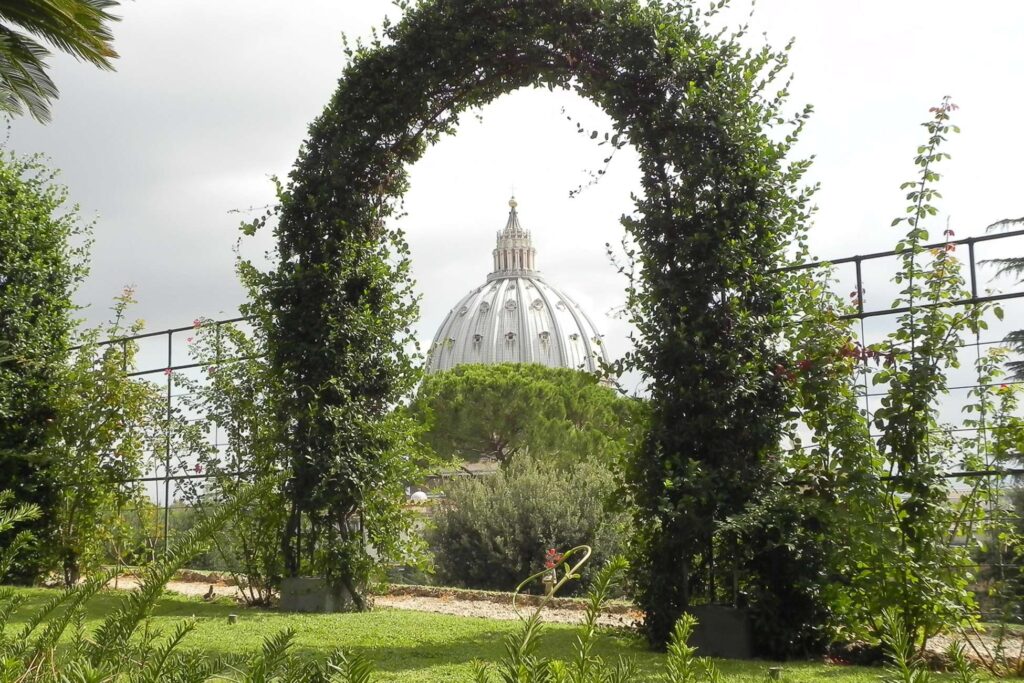
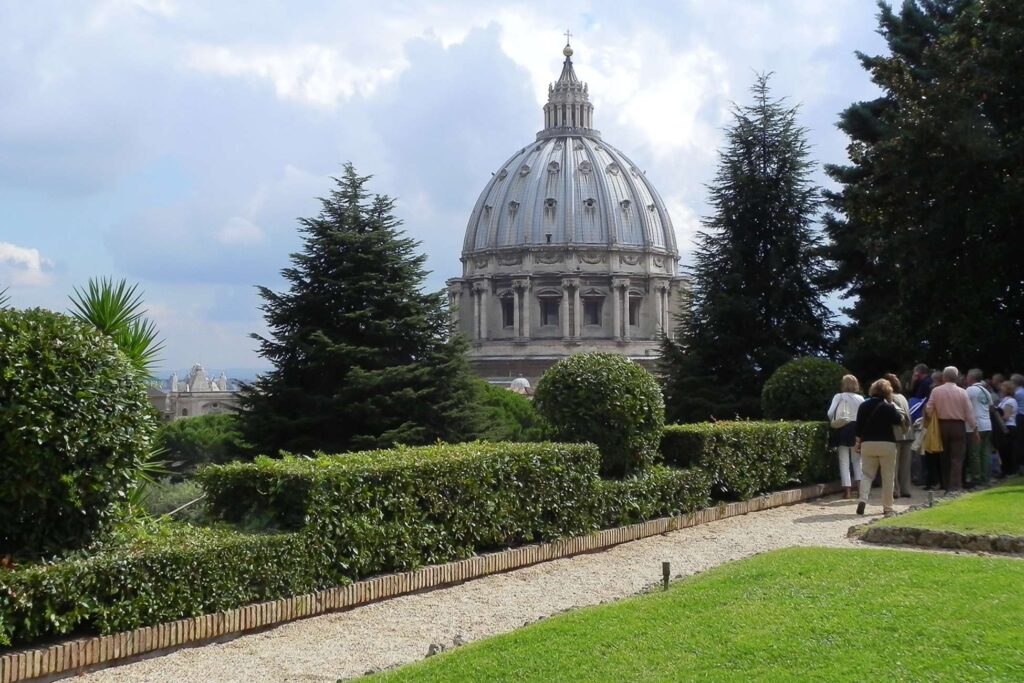
Begin where most visitors never linger—inside the papal gardens, a sanctuary of lawns, fountains, and shaded paths laid out across Vatican Hill. As your guide points out landmarks, you glimpse the Mater Ecclesiae Monastery tucked near the Eagle Fountain (Fontana dell’Aquilone), the discreet residence that sheltered Pope Benedict XVI after his resignation and has since returned to monastic life; just below lies Casina Pio IV, today home to the Pontifical Academy of Sciences. In another leafy corner, a fragment of the Berlin Wall stands like a concrete bookmark in history, its painted surface a startling counterpoint to clipped hedges and Roman pines. Views toward the dome offer a striking reminder that St. Peter’s is always near—even when it’s not yet on your route.
Prefer wheels to walking? One popular variant is the open‑bus circuit of the Gardens with a multilingual audioguide (about 45 minutes, no disembarkation), which can be paired with same‑day access to the Museums and Sistine Chapel. Walking formats also exist (typically around two hours for the Gardens segment), and your guide will set an even pace so you can absorb what you’re seeing rather than race from stop to stop.
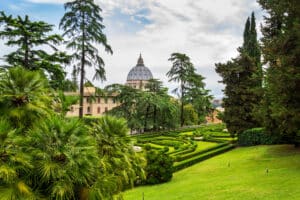
Vatican Gardens, Sistine Chapel and St. Peter’s Guided Tour
The Museums: a focused path through the icons
Once inside the Vatican Museums, you follow a time‑tested route—built to extract maximum meaning from a vast collection. In the Gallery of the Candelabra, marble giants flank your way beneath vaulted ceilings restored to their nineteenth‑century brilliance; it’s a stately overture that sets scale and tone. Then the rhythm changes as tapestries gather like woven stories—Flemish works derived from designs in Raphael’s circle—before the corridor opens into cartographic theater.
The Gallery of Maps is where many travelers feel the ground tilt from museum visit to time travel. Forty frescoed maps of Italy, planned in the 1580s by the mathematician‑monk Ignazio Danti under Pope Gregory XIII, line the hall like windows onto a peninsula before railways and motorways, each region paired with its ports and miracles painted in the gilded vault. Step back; let your eyes drift; the country assembles itself as if by memory.
Depending on the day’s flow, your guide may thread the route past the chapels associated with St. Pius V—spaces whose stuccoes and frescoes by Giorgio Vasari and Jacopo Zucchi whisper of Counter‑Reformation Rome—before steering you toward the final threshold. Routes can adjust for crowding or events, yet the through‑line remains: clarity, context, and breathing room.
The Sistine Chapel: silence, light, and rules that matter
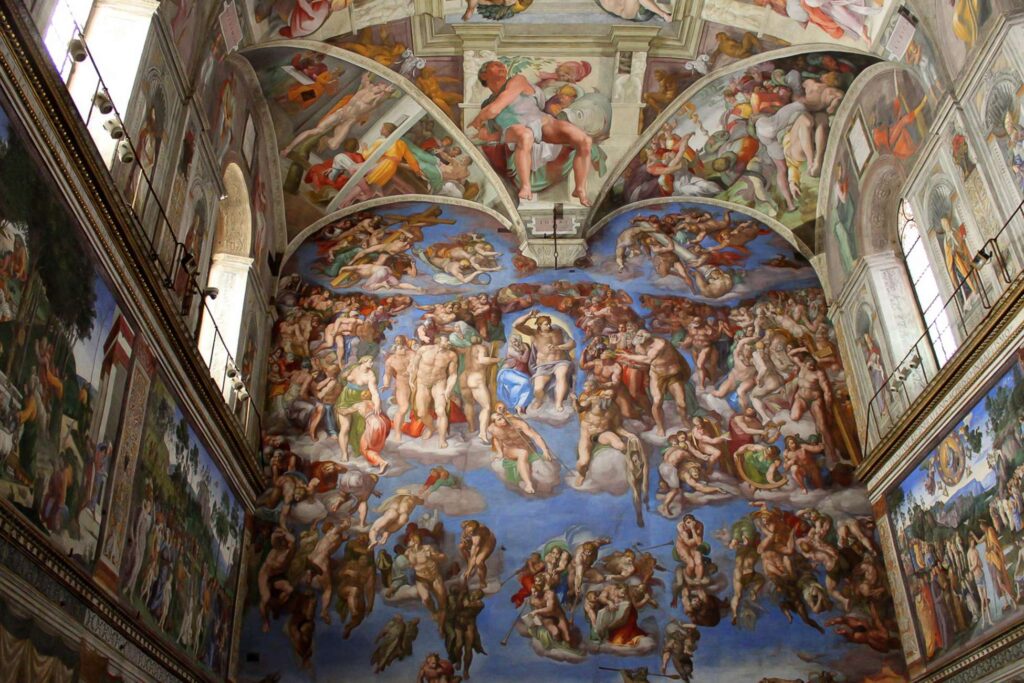
Inside the Sistine Chapel, the atmosphere changes. Conversation drops to a murmur, then to silence; guards remind everyone that this is a sacred space. Your guide will have done the explaining just before you enter (often using official screens outside), so you can simply look—Genesis scenes arcing across the ceiling, Prophets and Sibyls like carved thoughts, and The Last Judgment anchoring the altar wall. Photography and video are not permitted here—a firm policy—and flash is forbidden everywhere in the Museums. Headsets go quiet in the chapel; the art does the talking.
How the day flows—step by step
Meet near the Viale Vaticano entrance, where your guide organizes headsets, confirms the route, and escorts the group through security. The Gardens come first (serenely), followed by a targeted Museums pathway—Candelabra → Tapestries → Maps → selected chapels—arriving at the Sistine Chapel when your eyes are tuned to detail. Afterward, you either exit toward St. Peter’s (if permitted that day) or through the museum galleries, leaving time for the basilica on your own schedule. It’s a rhythm that favors comprehension over speed.
When your booking is confirmed, you’ll recieve a voucher with timing, meeting point, and identification requirements. Double‑check the opening/closure calendar close to your date; special liturgies or events can alter routes and room access on short notice.
- Skip the long lines to the monuments and sites of the Vatican City,
- Discover the top highlights of Vatican City,
- Admire the Sistine Chapel and appreciate Michelangelo’s renowned ceiling,
- Go inside St. Peter’s Basilica, one of the world’s greatest and most important churches,
- See masterpieces by Michelangelo, Leonardo Da Vinci, Caravaggio and more in the Vatican Museums.
Your booking secures timed, skip‑the‑line entry to the Vatican Museums and Sistine Chapel plus accompanied access to the Vatican Gardens (by open‑bus audioguide or on foot, depending on the option). A licensed guide leads the Museums portion, and radio headsets are used where required so you hear clearly without clustering. You still pass standard security screening (everyone does), but the ticketing line is bypassed—saving precious time and energy.
Entrance to St. Peter’s Basilica and especially the dome climb is not part of this tour. The basilica uses a separate security checkpoint in the square; entry to the church itself is free, while the dome requires a paid ticket. If you wish to visit after the Museums, allow for security lines and timing.
There is sometimes a guided‑groups exit from the Sistine Chapel that leads directly toward St. Peter’s. Availability depends on staffing and events and can be closed without notice; think of it as a helpful shortcut when it’s open, not a guaranteed feature.
Free cancellation up to 1 day before tour starts.
On returning to Rome after their exile in Avignon, the popes abandoned their Lateran Palace and took up residence near St Peter’s.
Work began in the fifteenth century, under the pontificate of Nicholas V (1447-1455); it was continued by Sixtus IV (1471-1484), who gave his name to the Sistine Chapel, and especially by Julius II during the Renaissance.
It is to this great papal builder that we owe the two most resplendent treasures of the Vatican: the ceiling of the Sistine Chapel, painted by Michelangelo, and the decoration of the Stanze and Loggia, by Raphael. The pontiffs ceaselessly improved their palaces right up to the end of the nineteenth century; taking their cue from Julius II, they acquired a huge quantity of objets d’art for the Vatican, in what has become a unique collection. Vatican City, the world’s smallest state (roughly 44 hectares or 109 acres) is now home to some ten museums or galleries covering every aspect of human knowledge and achievement.
There are paintings by the Italian Primitives and the best Renaissance artists, but also masterpieces of ancient sculpture, Egyptian and Etruscan art, gold and silver work, tapestry, and Greek pottery, together with ancient maps, and even collections of carriages and candelabra. But all the rest of the Vatican’s inexhaustible wealth is eclipsed by two undisputed masterpieces: the Stanze of Raphael and, even more famous, the Sistine Chapel. On the walls along both sides, the most talented Renaissance artists – Botticelli, Perugino, Pinturicchio, Ghirlandaio, and Luca Signorelli – prepared the way for Michelangelo, whose immortal fresco of the Last Judgement put the finishing touches to the chapel twenty years after he had painted the vault. After such a parade of magnificence, a visit to the Vatican gardens comes as something of a relief.
There is more to these gardens, though, than a respite from the crowds. They are quite simply full of poetry and very moving: it is a little-known fact of history that the Vatican gardens were constructed on the site of Nero’s and Caligula’s circus, where countless Christians were massacred.
Strolling amongst the flowerbeds and the clipped shrubbery, the visitor will chance upon a cemetery whose soil was brought back from Jerusalem, and a chapel where Charlemagne stood watch the night before his coronation. But all this is nothing compared to the view of St Peter’s dome; it leaps up at every instant and from every angle, round the corner from every grotto or fountain.
from €59.00 EUR
Duration: 11 Hours
Seller: Getyourguide
163 Reviews
from €50.00 EUR
Seller: Tiqets
1.049 Reviews
from €470.00 EUR
Duration: 3 hours
Organized by: Italy With Family
50 Reviews
from €74.00 EUR
Duration: 2.5 Hours
Organized by: Walks of Italy
1.504 Reviews
from €6.00 EUR
Duration: 1 Hour
Seller: GYG
1.351 Reviews
from €87.00 EUR
Duration: 3 Hours
Organized by: What a Life Tours
3. 135 Reviews
from €19.00 EUR
Duration: 3 Hours
Organized by: City Wonders Ltd.
2.812 Reviews
from €54.00 EUR
Duration: 1.5 Hours
Organized by: Touriks
10.098 Reviews
from €69.00 EUR
Duration: 3 Hours
Organized by: Maya Tours
1.050 Reviews
from €39.00 EUR
Seller: Tours & Tickets GmbH
32.598 Reviews