
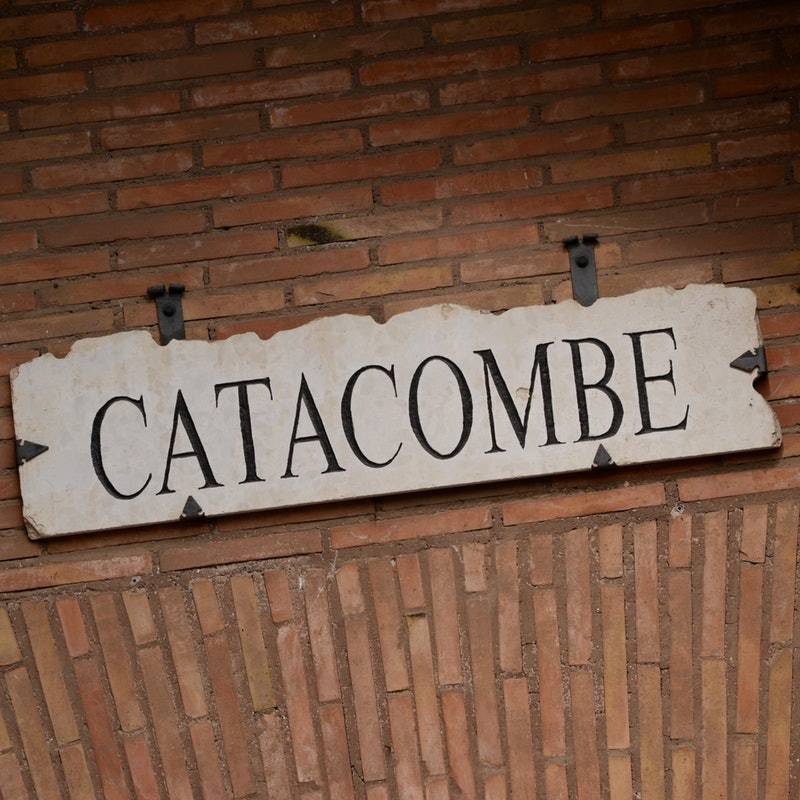
When planning your trip to Rome, it’s only natural to put the gladiatorial arenas of the Colosseum, the magnificent dome of the Pantheon, and the baroque details of the Trevi Fountain at the top of your list. However, once you step away from the noisy and crowded atmosphere of these iconic structures, you should know that a completely different world silently awaits you meters underground.
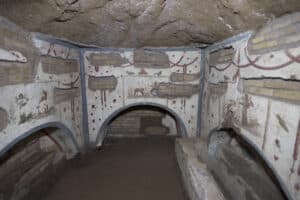
A few meters down, Rome shifts from noise to stillness—where fragile frescoes and deep history survive in dim light. Photographer: W Timothy Schaiff.
Due to the strict public health laws enforced in the ancient Roman Empire (especially the Twelve Tables — Lex Duodecim Tabularum) and the rules of the Pomerium, Rome’s sacred boundary, burying the dead within the city walls (the Aurelian Walls) was strictly forbidden. This strict law forced early Christians, pagans, and Jews to head outside the city to bury their dead and to carve out vast underground networks along the Appian Way (Via Appia Antica), Rome’s most important southern artery. The region’s unique tuff (tufo) rock geology, formed by volcanic eruptions and hardening upon contact with air to provide perfect insulation, made it possible to construct these massive engineering projects without them collapsing. Today, all these sacred underground networks are meticulously preserved and managed by the Pontifical Commission for Sacred Archaeology, which reports directly to the Vatican..
When browsing the web (travel forums, Reddit, etc.) and searching for best catacombs to visit in Rome Appian Way on international platforms, you’ll always come across three massive complexes: San Callisto, Domitilla, and San Sebastiano. The multitude of options and the historical weight of these places can easily create confusion about which one to visit. Moreover, this historical archaeological park sits completely outside Rome’s familiar central metro network. Considering the current tourism density and the regional changes brought on by Rome’s infrastructure projects, which underground tomb fully meets your expectations? And more importantly,how will you solve the transportation issue to this remote area stress-free, Considering the current crowds and ongoing infrastructure work in the city this year (2026)?
The Bus 118 Trap: How Not to Get to the Appian Way
When it comes to reaching the underground tombs on the Appian Way, the vast majority of travel blogs and standard guidebooks offer you a standard formula: exit at the Circo Massimo or Colosseum metro station and take the 118 municipal bus. This option, costing just 1.50 Euros with a standard 100-minute city pass (BIT), looks extremely budget-friendly and rational on paper. If you’re on a tight travel budget and have time flexibility, this public bus is definitely the first alternative you should consider. In practice, however, this plan often turns into an equation requiring immense flexibility and patience. So why shouldn’t you approach this option as if it were the only alternative?

The bus route looks simple on paper–but in real traffic, it often becomes a waiting game. Photographer: Inga Fortuna
Rome’s public transport system suffers from chronic disruptions due to heavy traffic, especially on routes leading to the outskirts of the historic center. Although the schedule for bus line 118 appears regular, Rome’s chaotic traffic constantly disrupts it. Under the scorching summer sun, you might find yourself waiting 40 minutes or more for a bus at a crowded stop with zero shade. When the bus finally arrives, you’ll have to endure a bumpy ride in a packed vehicle where the air conditioning barely works. Of course, there are more autonomous alternatives, such as renting an e-bike to pedal along the ancient road or calling a taxi/Uber from the center. However, cycling requires high physical effort during the hot months, and finding an available taxi to return to the center from the Appian Way — a rural park area — isn’t always guaranteed.

For more independence, an e-bike can be a flexible Appian Way option–if heat and effort fit your day. Photographer: Canary4stock
The more critical problem begins the moment you step off the bus or taxi. The Appian Way is a 2.300-year-old ancient road paved with large basalt stones, and there are no modern sidewalks in the sections where the catacombs are located. You have to press yourself against the high stone walls to protect yourself from the cars speeding by. This pedestrian traffic stress, especially when trying to reach the narrow entrance gates, ruins the mystical underground atmosphere before you even arrive at the site.
To avoid wasting hours in exhausting ticket queues and at unsafe bus stops, we strongly recommend choosing tours that provide air-conditioned transportation, picking you up directly from your hotel or a central meeting point, and connecting you seamlessly with an underground guide. This strategy completely solves the transportation problem while also eliminating any potential hour-long delays at the ticket counters.
You can explore Appian Way tour options that offer air-conditioned transportation from the city center, allow you to skip the ticket lines, and let you descend directly into the underground tunnels — secure your spot right away.
Which Catacomb Is Right for You?
The underground tombs of San Callisto, Domitilla, and San Sebastiano on the Appian Way each have a different historical mission, architectural structure, and set of rules. Trying to visit all of them in one day will be physically exhausting and, due to the similarity of the tunnel structures, will leave you feeling mentally repetitive. You should pick just one, or two at most.
San Callisto Catacombs: The Massive Resting Place of the Popes
If you’re drawn to sheer scale, official history, and institutional church hierarchy, your destination should be the Catacombs of San Callisto.
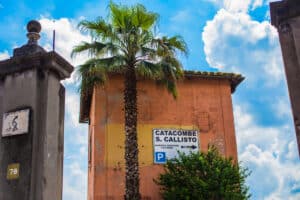
San Callisto is the heavyweight choice–vast tunnels, papal history, and high-season crowds. Photographer: Sun_Shine
Featuring a massive tunnel network approximately 20 kilometers long, this complex was established as the official cemetery of the Roman Church in the 3rd century AD under the initiative of Pope Zephyrinus. The most valuable part of this labyrinth is the special area known as the Crypt of the Popes, where 16 former popes, including the martyred Pope Sixtus II, are buried. The epigraphic marble inscriptions Pope Damasus added to these tombs still adorn the walls today. The original burial chamber of Saint Cecilia, one of the most famous figures of early Christianity, is also located within this complex.
San Callisto’s immense fame makes it a primary stop for large tour buses, religious pilgrimage groups, and schools visiting Rome. During the high season, you’ll constantly be shoulder to shoulder with other crowded tourist groups as you make your way through the tunnels. You should arrive prepared for this popularity and the intense pedestrian traffic inside.
- 2026 Fees and Hours: Full-price tickets are 10 Euros; discounted tickets (ages 7-16) are 7 Euros. Open from 9:00 AM to 12:00 PM and 2:00 PM to 5:00 PM.
- Closed Days: Closed every Wednesday and during the winter maintenance period, which usually lasts from mid-January to mid-February.
Domitilla Catacombs: For Those Seeking an Indiana Jones Vibe
San Callisto is a massive, 20-kilometer-long underground network famous for the tombs of popes. However, when evaluating these historic tunnels for their architectural integrity and atmosphere, our absolute favorite is the Catacombs of Domitilla. If you want to escape the tourist hustle and bustle of San Callisto, Domitilla will offer you the untouched, historical atmosphere you’re looking for. Its location on the Via delle Sette Chiese, a parallel axis very close to the Appian Way, keeps it relatively isolated from the tourist crowds.
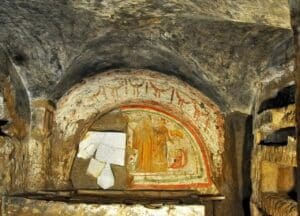
The Catacombs of St. Domitilla are the best preserved and one of the most extensive of all the catacombs. Photographer: Dennis G. Jarvis
.jpg)
At Domitilla, you descend into dimly lit tunnels through a massive ancient basilica (Basilica of Nereus and Achilleus) buried directly underground; the atmosphere is much more Indiana Jones-esque and highly authentic. Built on the private estate of Flavia Domitilla, a noblewoman of the Flavian dynasty who was exiled during the reign of Emperor Domitian, this cemetery boasts a network 17 kilometers long. Its relative isolation from tourist groups, its tranquility, and its striking frescoes of early Christian art make it incredibly valuable. As you walk through the tunnels, you can see right on the walls how figures from pagan mythology (such as Orpheus) were adapted to fit the motif of the Good Shepherd in Christian symbolism.
- 2026 Admission Fees and Hours: Full-price tickets are 10 Euros; reduced-price tickets are 7 Euros. Open for visits from 9:00 AM to 12:00 PM and from 2:00 PM to 5:00 PM..
- Closed Days: Closed every Tuesday and during the winter season from the end of December to the end of January.
We recommend booking your Domitilla Catacombs tickets in advance, allowing you to skip the crowds at the ticket office and descend directly into this authentic underground basilica alongside an official guide.
Catacombs of San Sebastiano: Where the Term “Catacomb” Originated
The etymological root of the word ‘catacomb‘ (underground tomb), which has entered world literature, comes directly from the Catacombs of San Sebastiano. In ancient times, this specific area was known as ad catacumbas, a Greek-derived phrase meaning “the place next to the pits“, due to its tuff stone mines and pits. Over time, this local name became a universal term describing all underground tombs.
These tunnels, which house the tomb of Saint Sebastian, boast a very different stratigraphy (layering) compared to the other two complexes. They aren’t just tunnels; they also house perfectly preserved first- and second-century pagan mausoleums that descend from the surface down into the earth. This complex also features the Memoria Apostolorum (Memorial of the Apostles) area, where early Christian tradition dictates the relics of Saints Peter and Paul were temporarily kept.
- 2026 Admission Fees and Hours: Full-price tickets are 10 Euros; reduced tickets are 7 Euros. Unlike other major tombs in the area, it doesn’t take a lunch break (siesta) according to the current 2026 operating schedule; it offers uninterrupted service between 9:15 AM and 5:15 PM.
- Closed Days: Closed on Mondays and during the winter maintenance period from December 2 to 22.
Things You’ll want to know before going underground
Descending 15–meters underground isn’t like a typical museum visit. To ensure a smooth experience and avoid disappointment, keep these operational facts in mind:
- Siesta Trap: While uninterrupted visits are possible at major museums in Rome, the underground tombs (except San Sebastiano) adhere to ancient Roman rituals and the need to preserve the underground microclimate by enforcing a very strict lunch break. The San Callisto and Domitilla ticket offices lock at exactly 12:00 PM, and staff leave the premises. If you arrive at the door at 12:15 PM, you’ll be forced to wait until 2:00PM on the Appian Way, where finding shade from the scorching heat is impossible. Be sure to schedule your visits between 9:00 AM and 11:00 AM, or after 2:30 PM.
- Underestimating the Underground Climate: While thermometers in Rome’s streets might show 38 degrees Celsius in mid-August, the temperature underground remains a constant 15 degrees year-round, thanks to the tremendous insulating properties of the volcanic tuff rock. Additionally, the humidity level in the tunnels is quite high. If you’re fooled by the warm weather and head down in light clothing, you’ll be cold during the 40-minute tour. Always carry a light jacket or cardigan in your backpack that you can easily put on and take off.
- Independent Visits Are Impossible: If you think you can buy your ticket at the ticket office and explore the tunnels freely at your own pace, you’re mistaken. You can only go underground accompanied by an official guide authorized by the institution. These tunnels are enormous, poorly lit, and lack any signage. Visitors are grouped according to their language for tours lasting approximately 30-40 minutes. Leaving the group or venturing into dark side passages is strictly prohibited for safety and historical preservation reasons.
- Don’t Violate the Dress Code: You might visit the Colosseum in shorts and a tank top, but the underground tombs are sacred religious sites belonging to the Vatican. The same strict dress code (decorum) rules that apply when entering the Vatican Museums or St. Peter’s Basilica apply here. You must wear clothing that covers your shoulders and knees.Visitors who don’t comply with the rules won’t be allowed into the tunnels, even if they have tickets.
- Zero Tolerance for Photography: Taking pictures with cameras or smartphones inside the tunnels is strictly prohibited. The “I won’t use a flash” excuse doesn’t work here. Stopping to take pictures in the narrow corridors blocks the pedestrian traffic of groups coming from behind. More importantly, electronic flashes cause irreversible damage to the pigments of the delicate, 1,800-year-old frescoes. Furthermore, this rule is strictly enforced to preserve the religious sanctity of the site. Put your cameras away in your bags and experience this authentic journey with your eyes only. It’s a known fact that anyone attempting to take pictures despite the guide’s warning will be immediately removed from the group.
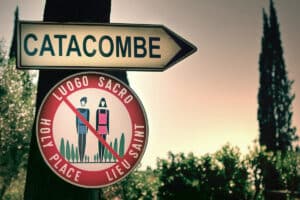
These are sacred sites, not casual attractions–dress code rules are enforced before you go underground. Photographer: MR_ross.
Architectural Dictionary: What Do the Wall Features Mean?
Your guide will frequently use Latin terms when describing the architecture of the tunnels. When looking at these walls, carved by a special guild of tomb diggers called Fossores in ancient Rome, knowing three basic terms will help you understand the structural differences:
- Loculi: Simple, rectangular, horizontal burial niches carved into the tunnel walls, where ordinary Roman citizens and early Christians were stacked on top of each other. They were usually covered with terracotta slabs or marble pieces. Often, the Chi-Rho (Christ’s monogram) or Ichthys (fish) symbols, representing the Early Christian period, were carved onto them.
- Arcosolia: These are much more ornate tombs than standard loculi niches, featuring arched tops and often decorated inside with religious frescoes. They were reserved for wealthy families or high-ranking clergy.
- Cubicula: These are small, independent burial chambers opening off the sides of long corridors, which could be closed off with iron or marble grates and were assigned to specific families.
Common Mistakes
To conserve your time and energy, you should avoid the logistical pitfalls that tourists often fall into. Underestimating claustrophobia is one of the biggest mistakes. The underground tunnels are barely wide enough for two average people to walk side by side. Most of the time, you’ll be passing through dimly lit, narrow corridors with low ceilings. There’s no elevator system, and access to the surface is via narrow stone staircases.It’scritically important to note here that, due to the architecture and physical structure of the tunnels (stairs and uneven ground), accessibility for wheelchair users or strollers is, unfortunately, impossible. Visitors with severe claustrophobia, asthma, or limited mobility must assess these physical conditions in advance.
Another major mistake is choosing the wrong footwear. The large basalt stones on the Appian Way and the uneven, sometimes damp earthen floor underground aren’t suitable for open sandals or thin-soled shoes. The ground can be slippery, and you’ll need to climb stairs in the tunnels. Make sure your footing is secure by wearing sturdy, thick-soled, closed-toe athletic shoes.
Exploring these massive engineering networks from the early Christian era is a factual historical journey completely different from exploring the Roman ruins above ground. By choosing the catacomb that best suits your interests, optimizing your transportation methods from the outset, and arriving prepared for the unchanging rules of the underground, you can manage your time on the Appian Way flawlessly. Choosing the right transportation package or public transport plan for your journey to the papal history of San Callisto, the authentic basilica atmosphere of Domitilla, or the etymological roots of San Sebastiano is the most important step you need to take to do justice to this historical discovery. Instead of wasting your time at bus stops, this adventure — where you will truly feel the historical texture — will be the most memorable part of your trip.
Leave a Comment