

Visiting both the Colosseum and the Vatican in a single day is an ambitious plan that many travelers consider. These two iconic sites are Rome’s greatest hits, each brimming with history, art, and sheer scale. But is it really possible to experience the grandeur of both in just one day without feeling rushed or missing out? It turns out that with smart planning and some compromises, you absolutely can – but prepare yourself for a whirlwind tour that kinda feels like an Olympic marathon of sightseeing.
Is One Day Enough for Both the Vatican and Colosseum?
It’s definitely a challenge to cover the Vatican City and the Colosseum area in only one day. Each location on its own can easily consume half a day or more:
-
The Vatican Museums are enormous – they contain around 70.000 artworks in total (with about 20.000 on display), spread across 8 miles of galleries and corridors. Even a focused visit “on fast-forward” will take at least 2 to 3 hours to see the highlights.
-
St. Peter’s Basilica, right next to the Vatican Museums, is the world’s largest church and holds treasures like Michelangelo’s Pietà and the stunning dome. It’s free to enter, but the security line can be very long (often another 30-60 minutes wait).
-
The Colosseum isn’t just an amphitheater to quickly peek at – your ticket also includes the sprawling Roman Forum and Palatine Hill ruins next door.This archaeological park covers a vast area where you could wander for hours, imagining ancient Romans around every corner. The Colosseum itself, a massive arena that once held up to 50000+ spectators, usually takes about an hour to tour inside if you’re efficient, but exploring the Forum/Palatine fully would require additional hours you probably won’t have.
Considering the sheer scale and significance of each site, squeezing both into one day means accepting that you won’t see everything in depth. We hafta prioritize the must-see sections and be okay with moving at a brisk pace (teh trade-off for covering maximum ground). One day is enough to get a taste of both the Vatican’s artistic wonders and Ancient Rome’s grandeur, but not enough to digest every detail. Think of it as a sampler platter of Rome: you’ll get the flavor, even if you can’t feast on every course.
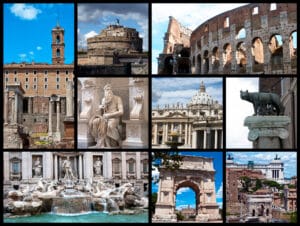
Rome in a day: Colosseum to the Vatican, with icons in between—Forum, Trevi Fountain, Castel Sant’Angelo, and the Arch of Titus.
On the bright side, countless travelers have successfully done the Colosseum and Vatican on the same day. It’s definately doable if you plan strategically and manage your time well. The key is to start early, stay flexible, and keep an eye on the clock while still enjoying the experience. Who wouldn’t wanna brag that in a single day they stood under the Sistine Chapel’s ceiling and inside the Colosseum’s arena?
Planning the Day: Which to Visit First?
A crucial decision is where to go first: the Vatican or the Colosseum? Both strategies have their merits, and the best choice can depend on the season, crowd patterns, and your personal travel style.
Most travelers opt to visit the Vatican first in the morning, and for good reason. The Vatican Museums open around 9:00 AM (with special early admissions even earlier), and the morning is your best chance to see the art collections before the crowds become overwhelming. If you arrive right at opening with pre-booked tickets, you can wander the halls and marvel at masterpieces like Raphael’s frescoes and Michelangelo’s Creation of Adam in the Sistine Chapel with relatively fewer people around. By late morning, the Vatican can turn into a packed house, and moving through the galleries becomes slow (in peak season it’s a “zoo” by mid-day). Starting here while you’re fresh allows you to appreciate the art and history more calmly. After finishing the Museums (and perhaps a quick look inside St. Peter’s Basilica), you can recharge during lunch and then head to the Colosseum once the worst of the midday heat passes.
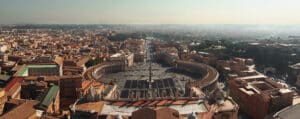
Panoramic view of Vatican City and Piazza di San Pietro
On the other hand, some prefer tackling the Colosseum first thing when it opens (around 8:30 AM). Early morning at the Colosseum means cooler temperatures (important if you’re visiting in the high heat of summer) and shorter security lines at the amphitheater. You could explore the Colosseum’s interior and maybe a bit of the Roman Forum in the early hours when these ancient stones aren’t yet baking under the noon sun. The downside is that this schedule puts your Vatican visit around mid-day or early afternoon, which is exactly peak time for crowds at the Museums and St. Peter’s. You’d be diving into the Vatican when it’s most crowded and potentially more exhausting. Unless you have a special skip-the-crowd tour or an afternoon entry that avoids lines, doing the Vatican second might feel more rushed in this scenario.
Overall, the consensus among many experts is to do the Vatican in the morning and the Colosseum area in the later afternoon. This way, you tackle the most crowded indoor site first, then enjoy the open-air ruins later in the day when you won’t mind a more relaxed pace (and when the lighting in the Forum towards evening can be beautiful). However, if you’re visiting during summer or a particularly hot day, consider flipping the order to put the outdoor Colosseum in the cooler morning and the indoor Vatican (which is air-conditioned) in the afternoon. Either approach can work – the important thing is to book timed tickets in advance for both sites so your schedule is locked in.
No matter which you start with, begin as early as possible at the first site, and plan a transition with some downtime in between. Rushing from one mega-attraction straight to the next without a break is a recipe for burnout. We’re gonna need a breather!
One-Day Itinerary for Rome’s Highlights
Let’s paint a picture of how a single day visiting the Vatican and Colosseum might unfold. The key is a disciplined schedule that still leaves room for enjoyment:
Morning: Immersed in the Vatican’s Treasures
7:30 – 9:00 AM: Start Early (Optional Tour) – If you can swing it, take advantage of special early entry options. Some tour companies offer a “Pristine Sistine” tour or first-entry tickets that let you into the Vatican Museums around 7:30 or 8:00 AM, before the general public. This is a fantastic (if pricey) way to admire the Sistine Chapel with a small group. You might find yourself nearly alone under Michelangelo’s painted heavens, a once-in-a-lifetime feeling. Even without a tour, aim to arrive by 8:30 AM at the Vatican Museums entrance so you’re among the first when doors open at 9.
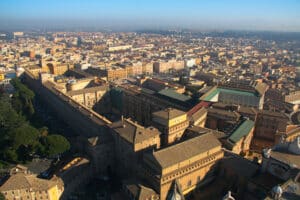
A museum city within a city—the Vatican Museums’ immense footprint, connecting palaces, courtyards, and the Sistine Chapel.
9:00 – 12:00 PM: Vatican Museums and Sistine Chapel – Once inside, focus on the highlights. The Vatican Museums are a labyrinth of art; it’s tempting to get lost in every gallery, but with limited time you should prioritize famous sections like the Raphael Rooms, the Gallery of Maps, and of course the Sistine Chapel (which is at the very end of the museum route). Moving purposefully, you can cover the major sights in roughly 2.5 hours. That may sound rushed for a museum that could easily fill an entire day, but you’ll still witness an incredible breadth of art – from ancient statues to Renaissance tapestries – as you wind your way through. Remember, it’s okay to skip some lesser-known rooms; you can’t see everything. Keep an eye on your watch so that by around noon you’re wrapping up your museum visit.
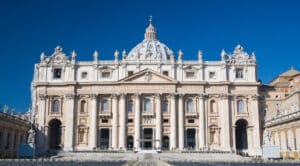
St. Peter’s Basilica from St. Peter’s Square: a grand entrance to the Vatican and home to Bernini’s bronze baldachin inside.
12:00 – 12:30 PM: St. Peter’s Basilica (Quick Visit) – If seeing inside St. Peter’s is a priority, now’s your chance. Normally, exiting the Sistine Chapel leads you out of the museums, and you’d have to walk around to St. Peter’s Square and go through another security line to enter the Basilica. However, one hack (that’s not guaranteed but often works) is to use the special door in the Sistine Chapel that’s intended for tour groups – it leads directly into St. Peter’s, bypassing the external security queue. Officially, it’s for guided tours only, but sometimes independent visitors manage to tag along through that door if a guard allows it. If you took an organized tour, your guide will lead you straight into the Basilica through this shortcut. Inside St. Peter’s, take a few moments to gaze at the soaring dome, Bernini’s bronze canopy (the Baldacchino), and the sunlit interior. Given our tight schedule, you might spend only 30 minutes here – enough to walk down the nave, appreciate Pietà, and even descend briefly into the crypt to see St. Peter’s alleged tomb. It’s a breathtaking church and entry is free, but budget time wisely. (If lines or timing don’t allow a Basilica visit now, you could choose to skip it or return another day if possible.)
Midday: Lunch and a Dash Across the City
12:30 – 1:30 PM: Lunch Break – By now you’ve been on your feet all morning, soaking up intense art and history. It’s vital to take a break – you’ve earned it! There are cafes and restaurants in the vicinity of the Vatican.Perhaps grab a quick panini or a plate of pasta at a nearby trattoria in the Prati neighborhood. Use this time not only to refuel on Italian carbs and espresso, but also to rest your legs and recharge mentally. Reflect on all the amazing things you just saw – but don’t relax so much that you lose track of time. We’ll need to head to the Colosseum soon.
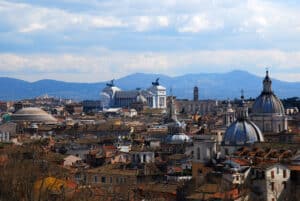
A classic Rome view: the Pantheon’s dome and the Monument to Victor Emmanuel II (Vittoriano) rising over the historic center.
1:30 – 2:00 PM: Travel from Vatican to Colosseum – The Vatican and the Colosseum sit on opposite sides of Rome’s city center, roughly 4 km (2.5 miles) apart. This isn’t a trivial distance when time is short. The fastest way to connect the two is by taxi or rideshare – a cab ride takes around 15–25 minutes without heavy traffic and drops you right at the Colosseum’s entrance. Public transportation is cheaper but can be a bit slower: one option is the Metro (subway) – you’d take Line A from Ottaviano (near the Vatican) towards Termini, then switch to Line B towards Laurentina and get off at Colosseo station. The metro journey itself is maybe 20 minutes, but factoring in walking to the station, waiting for trains, and the transfer at Termini,it can easily be 30-40 minutes total. Buses like the #64 /or/ #40 also connect the Vatican area to the historic center, but they can be crowded and slow due to traffic. Overall, give yourself around an hour for the transfer just to be safe – especially if you plan to use public transport or if Rome’s notorious traffic is in play. We really don’t wanna miss our reserved Colosseum entry time because of a transportation delay. (And please don’t attempt to walk the whole way – yes, it’s walkable in about 60 minutes, but you’ll be walking plenty inside the sites themselves, and every minute counts when you only have one day.)
Afternoon: Exploring Ancient Rome’s Heart
2:00 PM: Colosseum Entry (Timed Ticket) – Ideally, you will have booked a timed entry for the Colosseum in advance, perhaps around 2 PM or 2:30 PM (whenever you’re confident you can arrive by, considering transit). Showing up with a reservation lets you skip the ticket-buying line, but do note that everyone still has to pass a security checkpoint. Security lines at the Colosseum can take 15-30 minutes or more, depending on crowds and time of day. In peak season, even with a booking, it’s wise to arrive 30 minutes before your slot to account for the security queue. Once you clear security and step into the Colosseum’s ancient arena, take a moment to appreciate where you are. Two thousand years ago, this stadium roared with 50000 spectators cheering gladiator battles – now we stand among its weathered arches and tiered seating, dwarfed by history.
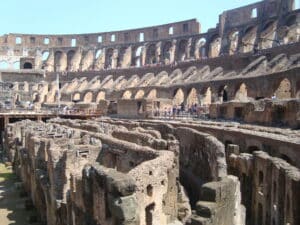
Colosseum and Underground chambers
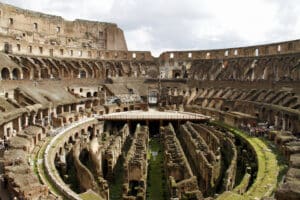
Interior of Colosseum
Spend about an hour inside the Colosseum. With limited time, focus on key features: walk the perimeter of the main level to see the interior structure and the exposed underground chambers where animals and fighters once awaited, and climb up to the second tier for a better view of the whole amphitheater. There are informational signs and maybe small exhibits; take a quick glance but you probably won’t read every detail. Snap those quintessential photos through the Colosseum’s arches with the modern city in the background. It’s a surreal contrast of ancient and new. If you find yourself lingering, just remember we still have more to see – keep an eye on the clock.
3:30 PM: Roman Forum and Palatine Hill – After exiting the Colosseum,your ticket also grants access to the Roman Forum and Palatine Hill archaeological area next door. By mid-afternoon, entry lines here are usually short or nonexistent (most people enter earlier in the day). Wander through the Forum along the main Via Sacra, imagining it as the bustling epicenter of the Roman Empire. You’ll pass the Arch of Titus, the basilicas and temple ruins, and the grassy remains of what was once a grand civilization’s downtown. Given our tight schedule, it might be wise to prioritize a few highlights: for instance, the Temple of Julius Caesar (where he was cremated), the Vestals’ House and Garden, and the view of the Forum from the foot of the Capitoline Hill near the Curia (Senate house) ruins. Then make your way up the Palatine Hill path if energy permits – from up there you get a panoramic vantage point over the Forum on one side and the Circus Maximus on the other. There’s a small museum atop Palatine and the legendary huts of Romulus, but with limited time, a quick walk through the palace ruins to a viewpoint might suffice. You’ll probably spend at most an hour exploring the Forum/Palatine area, wrapping up by 4:30 or 5:00 PM.
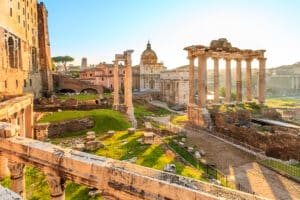
Roman Forum
Keep in mind, by this time many travelers are wilting from fatigue – it’s been a long day. Feel free to find a fountain to refill your water bottle (there are public drinking fountains, called “nasoni”, around Rome) and sit on a marble fragment to rest for a moment, contemplating the rise and fall of an empire. It’s a lot to take in. If you find yourself short on time or energy, it’s okay to trim the Forum visit – even just peeking in from outside or from Capitoline Hill can give a sense of its scope. Some visitors choose to focus mainly on the Colosseum itself and skip an in-depth Forum walk-through when time is scarce.
5:00 PM: Wrapping Up Your Day – As late afternoon turns to early evening, you’ve officially conquered two of Rome’s most formidable sightseeing giants in one day! If you exit the Forum near Piazza Venezia, you might catch a bus or taxi back to your hotel or walk a bit through the city center. Or maybe you’ll have a burst of second wind and wander to nearby sights like the Capitoline Museums or Trevi Fountain (if you somehow still have pep in your step). But most likely, you’ll be ready to find a nice place to collapse – perhaps at a trattoria with a cold drink.
Guided Tours vs. DIY: What’s the Best Way in One Day?
When time is of the essence, joining a guided tour can be a lifesaver – though it comes at a monetary cost and a bit of reduced flexibility. There are tour companies that specifically offer “Rome in a Day” packages, covering the Vatican and Colosseum (and sometimes a few other stops) all in one full-day itinerary. Here’s how the options stack up:
-
Guided Tour (especially Private Tours): The biggest advantage is efficiency.A good tour will handle all the logistics – securing skip-the-line tickets, providing transport between the Vatican and Colosseum, and whisking you through each site’s highlights on a tight schedule. Skip-the-queue entry is often included, which means you save potentially hours by bypassing the long public lines. With a private tour or small group, you also get a knowledgeable guide who can share key facts and stories, enriching your experience (and ensuring you don’t waste time lost or looking for what’s important). Many travelers find that guides help keep the pace brisk but smooth; for example, a guide at the Vatican can lead you through the maze of galleries directly to the star attractions without backtracking. If you go the private tour route, you’ll have even more control – the guide can tailor the day to your interests and energy level, and you won’t have to accommodate other group members. The downside, of course, is cost: full-day combo tours can be quite expensive, especially private ones. Also, tours run on a fixed schedule – you might sometimes wish for an extra ten minutes in the Sistine Chapel, but the group has to move on to stay on track. Overall though, for many with only one day to spare, a tour is worth it for the convenience. It can feel like traveling with a fast-pass and a personal history teacher by your side.
-
Do-It-Yourself (Individual Exploration): Going on your own offers maximum flexibility – you decide how long to spend at each spot and can linger where your curiosity pulls you (or leave early if you’re feeling overwhelmed). It’s also cheaper; you’ll pay just for the entry tickets and transport, not for guiding services. Some travelers thrive on the freedom and prefer to explore at their own pace with an audio guide or guidebook in hand. However, when attempting Vatican + Colosseum in one day, DIY requires serious preparation to avoid pitfalls. You must book your tickets well in advance (for both the Vatican Museums and the Colosseum time slots) to avoid getting shut out or stuck in endless lines. You’ll need to be your own timekeeper to ensure you leave the Vatican on schedule to make your Colosseum slot (no one wants to be across town fretting that their entry window is closing!). Without a guide, you might miss some context or take longer to find certain famous artworks or vantage points. And if anything goes awry (say, a sudden museum closure or a transit delay), you’ll have to troubleshoot on the fly. It’s definitely doable, especially for seasoned travelers, but it demands a bit more mental energy and discipline.
In summary, if budget allows and you’re keen on a stress-free experience, a guided “two-in-one” tour (ideally a small group or private tour) is a fantastic option. It ensures you’ll hit all the highlights efficiently and learn a ton along the way, essentially making the impossible possible. On the other hand, if you prefer independence or are traveling on a tighter budget, planning it yourself is still feasible – just be sure to plan meticulously and act like your own tour guide: schedule out the day, reserve tickets, and even study a bit beforehand so you know what you’re looking at.
(One middle-ground approach some travelers take is booking a guided tour for one site (say, a morning Vatican tour that ends at St. Peter’s) and then doing the other site on their own in the afternoon. This way you get the benefit of a guide when you most need it – arguably the Vatican’s complex museums – and then a freer schedule later for the Colosseum, which is more straightforward to visit independently, especially with an audio guide.)
Tips to Make the Most of a Whirlwind Day
Taking on the Colosseum and Vatican in one day is a bit like a high-energy scavenger hunt through history. It can be incredibly rewarding if you come prepared. Here are some practical tips to help you survive and thrive during this action-packed day:
-
Book Everything in Advance: This cannot be stressed enough. Purchase your Vatican Museums ticket (with a timed entry) and your Colosseum combo ticket online well before your trip. Same-day tickets are risky or sometimes impossible to get due to popularity. Advance tickets let you skip the ticket-buying lines (though you still go through security). If you plan on climbing St. Peter’s Basilica dome or visiting the Colosseum’s underground or arena floor (special sections), those require separate reservations too. Having all your tickets pre-booked will save you hours of waiting.
-
Start Early: Begin your day as early as you can manage, even if it means an early alarm. The payoff is experiencing at least one of the sites with fewer crowds and cooler temperatures. Rome’s public transport also gets more crowded later in the morning, so beating the rush hour helps.
-
Use Efficient Transportation: Don’t underestimate Rome’s traffic and distances. Plan your route from Vatican to Colosseum ahead of time – whether it’s having the number of a taxi service, using a ride-hailing app, or knowing the metro stops. When in doubt, a taxi is the quickest; yes it costs more than the bus, but when you’re trying to do two days’ worth of tourism in one day, every minute saved is precious.
-
Pack Light and Smart: You’ll be on the move all day, so wear comfortable walking shoes (this is not the time for new sandals that haven’t been broken in). Carry a small backpack or bag with the essentials: water bottle, some snacks (a granola bar or fruit for an energy boost), sunscreen and a hat (if it’s sunny), and a light scarf or shawl. The scarf can cover your shoulders or knees in the church if needed for dress code, and also serve as sun protection. Having a compact umbrella or rain poncho is wise if rain is in the forecast. Remember that large backpacks or luggage aren’t allowed in the museums or Colosseum, and you’ll lose time if you have to check bags, so keep it minimal.
-
Stay Hydrated and Take Breaks: In the excitement of running from site to site, don’t forget to drink water. Rome often gets hot by afternoon, and all that walking (possibly 15.000+ steps in the day) can sneakily dehydrate you. Refill your water bottle at the fountains. Take short breaks when you can – even 5 minutes of sitting in the shade in the Forum, or on a bench in a Vatican courtyard, can help your body recover. A hurried day doesn’t mean you can’t pause occasionally to just soak in the atmosphere – those moments can be the most memorable.
-
Adjust Your Expectations: Perhaps the most important tip is a mental one: go in knowing that you cannot see everything thoroughly. You might not get to linger in the Sistine Chapel as long as you’d like, or you might breeze past exhibits that you find interesting simply because time is tight. And that’s okay. Don’t let FOMO ruin the experience. Instead, celebrate what you are getting to see. Millions of people would envy standing in your shoes at these world wonders, even if only for a short time. By focusing on the top highlights and accepting that this is a “highlight reel” kind of day, you’ll enjoy it more. It’s a bit like sprinting through a museum – not ideal for deep contemplation, but you’ll catch the masterpieces.
-
Mind the Closing Times: Keep track of when each site closes on the day of your visit. The Vatican Museums usually have last entry in the afternoon and start ushering people out by early evening (exact times depend on season/weekday) – you’ll be done there by midday in our plan, but just be aware. The Colosseum’s final admission is typically about one hour before sunset, which can range from 3:30 PM in winter to 6:00 PM or later in summer. Don’t plan to arrive too late in the day. Also note that the Forum/Palatine area closes slightly earlier than the Colosseum sometimes, to ensure visitors exit before dark. Check the official schedules so you’re not caught off guard if, say, the Forum starts clearing out at 6:15 PM.
-
Have a Backup Plan: Despite your best-laid plans, things can happen. Maybe a public transport delay, or you end up spending more time at the Vatican because you couldn’t resist. If you see you’re running significantly behind by lunch, be prepared to adjust. For example, if you won’t reach the Colosseum in time for your reserved slot, try to modify it or use the Forum/Palatine part first (since those might be more flexible) and enter the Colosseum later. Or, in a worst-case scenario, decide which site means more to you and dedicate quality time to that, and save the other for another trip. It’s not what we aim for, but flexibility can save the day if needed.
By following these tips, you’ll maximize your chances of having a smooth and enjoyable day. It’s going to be a busy day no matter what – but with the right approach, it can also be one of the most memorable days of your travel life.
A One-Day Triumph in Rome
Pulling off visits to the Colosseum and the Vatican in the same day is no small feat. It demands energy, planning, and a dash of daring, but it also offers an unparalleled payoff. In just a single sun-up to sun-down span, you’ll travel from the heights of Renaissance art and spirituality in the Vatican to the core of ancient gladiatorial drama at the Colosseum. Few other days in your life will cover 2000 years of history in a matter of hours.
Yes, it might be a bit of a crazy adventure – at times you’ll feel like you’re racing against the clock, and your feet might beg for mercy by late afternoon. Yet, by evening when you’re savoring a well-earned bowl of pasta and reflecting on the day, you might just marvel at all you’ve seen. Not everyone has the luxury of multiple days in Rome, and for many travelers this blitz-tour is the only way to witness both world-famous sites.
Despite the fatigue, you’ll have the satisfaction of knowing you made the most of every moment. After all, standing in the Sistine Chapel and the Colosseum in one day is the kind of story you’ll be telling for years. With smart planning and realistic expectations, that story will be less about stress and more about awe. So go ahead – if one day is all you have, embrace the challenge and dive into Rome head-first. When in Rome, you gotta do what you gotta do, and sometimes that means conquering the Colosseum before lunch and saying hello to the Pope’s backyard by dinner. It’s an experience that’s demanding, yes, but also deeply rewarding – a Roman rendezvous with history that you’ll never forget.
Leave a Comment